Corporate Strategy
Purpose and Vision
Covestro’s purpose, “To make the world a brighter place,” remains the foundation of our actions. In an environment increasingly shaped by geopolitical tensions, volatile markets, and economic challenges, Covestro continues the pursuit of its vision of becoming fully circular. This vision forms part of our Group’s Sustainable Future strategy and is aligned with the global challenges we have to face, such as advancing climate change, rising environmental pollution, the continuous growth of the global population, increasing urbanization, as well as new forms of mobility and the transition to renewable energies.
Our high-performance polymer materials can be part of the solution to the global challenges. In pursuing it, we rely on technologies that reduce energy usage and emissions in our production processes. The products and solutions we develop are replacing traditional materials such as glass and metal, which are manufactured less sustainably or have a less sustainable life cycle. They also enable entirely new sustainable applications. We are convinced that our long-term strategy of pursuing a circular economy will bring us closer to achieving our purpose to make the world a brighter place.
Our vision of becoming fully circular is the ultimate goal for our Group’s Sustainable Future strategy. Our vision therefore sets a clear direction for our company’s future development.
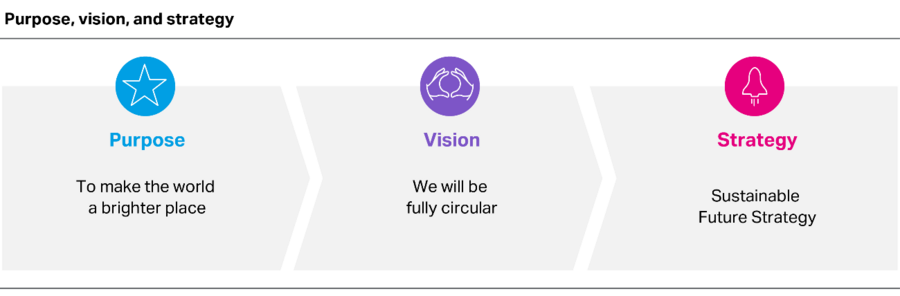
Our corporate values and corporate culture are major factors in putting our purpose, vision, and strategy into action.
For further information, please refer to www.covestro.com/en/company/our-company/our-culture
Group Strategy
Strategic Goals and Activities
Our Group’s Sustainable Future strategy sets the direction for us always to keep an eye on our overarching goals – derived from our purpose and our vision – even in times of change. »ESRS 2.45 (c) In view of the increasing geopolitical tensions and continuing weak market dynamics of recent years and to meet the changing needs of our stakeholders, Covestro revised and updated the Group strategy in fiscal 2025.«
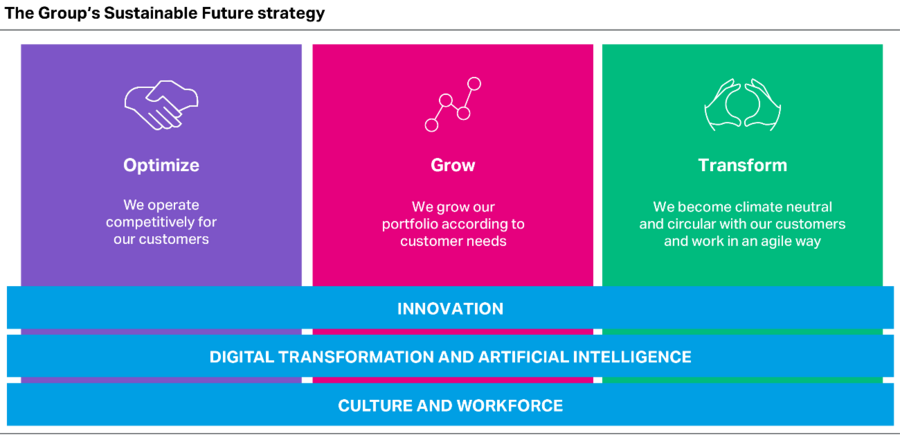
Our strategy has kept its basic direction, although critical adjustments were made in the year 2025: We have sharpened the focus in these three strategic chapters, "Optimize," "Grow," and "Transform," and generate momentum by setting clear priorities and ensuring consistent implementation across all time horizons. We will “optimize” in the short term, “grow” in the medium term, and permanently “transform.” We have firmly embedded the customer perspective at the core of all chapters, placed greater emphasis on the time perspective, and fleshed out the details for the path toward our sustainable and profitable transformation. In addition to a strong corporate culture, a workforce that is fit for the future, artificial intelligence (AI), and the digital transformation, innovation is now also included as an enabler and key success factor. »ESRS 2.45 (c) iii We expect these changes to affect our relations with stakeholders. As a result of embedding the customer perspective, we expect, e.g., customer satisfaction to increase further. We anticipate furthermore that our clear commitment to further optimization, growth and sustainability, as well as innovation will encourage our stakeholders to maintain a positive attitude toward our company. «
“The Customer Perspective is Firmly Embedded in Our Strategy”
The customer perspective is deeply embedded in our strategy. It runs like a thread through all elements of our strategy and underscores our objective to act as a competitive partner for our customers, to develop our portfolio according to customer requirements, and to be agile in working toward becoming climate-neutral and circular together with our customers. The aim is to achieve net-zero emissions (“Net-Zero”) in a concerted effort with all those involved along the value chain and at the same time to realize our vision of becoming fully circular in the long term. For us, this is centered on customer satisfaction, which is regularly measured using the NPS – a metric that reflects our customers’ willingness to recommend our company to others.
Optimize
We act as a competitive partner for our customers – with our first strategic chapter, we want to direct our short-term focus on operational excellence and financial strength to leverage our full potential and in this way create the basis for growth and our transformation. Our three focal topics in this chapter are trained on the success factors of our core business. They include raising plant availability, increasing cost efficiency, improving our liquidity position, as well as tapping into new markets and increasing margins.
The first focal topic relates to improving plant availability. In the year 2023, we marked the starting point by launching targeted maintenance projects to make our workflows even more reliable and efficient. In this way we make sure that we always remain a reliable partner for our customers and can guarantee high delivery reliability at any time. The actions implemented already had some success in this past year, e.g., an increase in the volumes of MDI produced.
As the second focal topic of the first strategic chapter, we have set ourselves the target of further optimizing our cost position and boosting our liquidity. To this end, we initiated the global “STRONG” program in the year 2024. Given the rapidly changing business environment, STRONG is aimed at accelerating Covestro’s successful further development and securing our long-term competitiveness. The program puts the focus on optimizing existing structures and processes, especially in production and administration. By increasing efficiency and promoting digitalization throughout the Group, we aim to harness STRONG to realize annual global savings of €400 million by the end of 2028.
Moreover, under the third focal topic, we work to tap into selected new markets and increase our margins. In the Solutions & Specialties reporting segment in particular, we specifically target new markets, e.g., in the healthcare sector, and existing growth markets such as electromobility, energy-efficient construction, and renewable energies.
For further information, please refer to “Value Chain – Marketing and Sales.”
Grow
We develop our portfolio according to customer requirements – with our second strategic chapter, we want to expand our portfolio systematically in the medium term and take targeted and sustainable steps toward driving our profitable growth. We have clearly defined our top three priorities for medium-term growth: Adapt our portfolio, increase plant capacity utilization, and make targeted investments.
To realize our vision of a future-proof target portfolio, we have made the adaptation of our portfolio the first focal topic of our strategic chapter, “Grow.” We operate in market segments that are attractive and sustainable for the long term. By proactively managing lifecycles and customer centricity, we hone our product portfolio and set ourselves more clearly apart from the competition. On this basis, we develop our product portfolio in attractive regions, which can meet customer needs efficiently with the aim of harnessing above-average benefits from market growth for Covestro.
Under the second focal topic of the second strategic chapter, we promote growth in the Solutions & Specialties segment by increasing plant capacity utilization through selective changes to our product mix. On this basis, we generate growth despite limited investment opportunities and contribute to improving our fixed cost coverage.
All activities that promote organic and inorganic growth are embedded in the third focal topic – including investments in new production facilities and infrastructure, acquisitions, and our strategic venture capital initiative (Covestro Venture Capital, COVeC); they are performed in a targeted manner, geared toward profitability and sustainability. In this way, we safeguard and expand our market position. In addition, we promote selective inorganic growth through mergers and acquisitions (M&A), guided by our aim to create added value. This roadmap stakes out the framework for expanding our core business, gaining market share, and leveraging efficiencies. It will also enable us to acquire new business areas to gain access to new markets, customer segments, and technologies, as well as to extend our geographic reach. We also want to take advantage of the opportunities of forward and backward integration to leverage additional potential for improvement along the value chain. In order to generate maximum value with the capital invested, we are analyzing and managing our investment portfolio according to profitability and sustainability criteria. We support investment projects with a return on capital employed (ROCE) above certain thresholds that generate the lowest possible GHG emissions or even bring about a reduction.
For further information, please refer to “Management System.”
For further information, please refer to “Sustainable Solutions.”
Transform
We are agile in working toward becoming climate-neutral and circular, together with our customers. With the third strategic chapter, we want to transform Covestro permanently to make it fully climate-neutral and circular. The three focal topics in this chapter aim to accelerate the development of a climate-neutral and resource-conserving economy. We want to become climate-neutral and develop a circular portfolio for and with customers as well as build a performance and agility culture to master our transformation. We see this orientation as an opportunity for a lucrative transition to climate-neutral and circular solutions for our customers throughout the entire value cycle, which will also offer benefits for society and the environment.
In this context, the first focal topic of the third chapter deals not only with reducing direct and indirect (Scope 1 and Scope 2) greenhouse gas (GHG) emissions, but also follows specific roadmaps aimed at avoiding upstream and downstream GHG emissions along the entire value chain (Scope 3). Covestro plans to achieve net-zero emissions for Scope 1 and Scope 2 by the year 2035. Likewise, the intermediate reduction target for Scope 3 emissions* has been set for the year 2035: –10 million metric tons of CO₂ equivalents (–30% compared to the base year of 2021**
In terms of the circular economy, we consider both the upstream and the downstream value chain while anticipating changes in the availability of raw materials, pending regulatory impacts, and corresponding shifts in market demand. Under the second focal topic in the third chapter, we develop and monetize a circular portfolio jointly with customers and partners – based on solutions and products that integrate alternative sources of carbon into our raw materials and optimize resource use through design and end-of-life solutions. These insights serve as a basis for, among other things, updating business activities at Covestro, e.g., through innovation, selected investments and procurement, marketing, and sales.
For further information, please refer to “ESRS E1: Climate Change.”
For further information, please refer to “ESRS E5: Resource Use and Circular Economy.”
We also want to drive the circular economy by developing and using innovative recycling options. In this context, we consider chemical recycling particularly promising as an effective tool for reclaiming considerable quantities of feedstocks for reuse. It is suitable primarily for materials and waste that cannot be mechanically recycled due to their properties or when the recycling process must produce like-new materials.
We are aware that shifting our production activities and our product portfolio to circular economy is a major, long-term undertaking that we cannot accomplish alone. For this reason, we continue to redouble our efforts to establish partnerships and networks with our customers, suppliers, research institutes, and other solution providers throughout the value cycle.
»ESRS 2.40 (f) The needs of our customers along the entire value chain, specifically in relation to sustainability, are regularly reviewed and analyzed. This analysis indicates to Covestro which Covestro products are particularly relevant for the sustainability targets of its customers.
Examples include mass-balanced products based on our CQ solutions. These CO2-reduced variants of Covestro products help Covestro at the same time to meet its own sustainability targets, such as climate neutrality.«
For further information, please refer to “ESRS E5: Resource Use and Circular Economy.”
As the third focal topic, we are building a performance and agility-oriented culture that puts us in a resilient and profitable position in dynamic markets. To this end, we are updating the way we work and are adopting a new approach with the latest project management methods and tools.
Innovation
Innovation – an elementary component and enabler of our Sustainable Future strategy – provides the foundation for our future viability. Our innovation promise is: “Turning brave ideas into innovative materials for a sustainable future.” In this context, we create high-performance material and technology innovations for a brighter world to live in – with added value for customers and Covestro. Innovation at Covestro has three focus areas: We safeguard our current business by ensuring that our products always meet regulatory standards, high quality levels are maintained, and customer requests can be fulfilled, as well as that our processes meet the technical requirements. But at the same time, innovation is also a driver of growth, both in adjacent markets, products, and applications, and in disruptive areas that support our transformation. This also includes the development of innovative solutions, technologies, and products needed to set ourselves apart from the competition and to adapt the portfolio to new requirements and potential. It is critical in this regard to be innovative in all activities and to drive the commercialization of product, technology, and application innovations. In this context, we also use digital research and development (R&D), in particular quantum computing and artificial intelligence. Examples are the expansion of our digital R&D activities and collaborations with partners such as Google. Insights provided by data science strengthen the ability of corporate functions to profitably deploy algorithms and machine learning. We systematically promote the development and implementation of these digital products.
For further information, please refer to “Innovation.”
Artificial Intelligence and Digital Transformation
Artificial intelligence (AI) and digital transformation are further key elements in paving the way for our strategy. We are focused on tackling AI and digital transformation and the associated opportunities by implementing an extensive range of measures along the entire value chain, in the corporate functions, and at all points of contact with our customers. This involves Covestro promoting the use of digital technologies and leveraging the potential of AI. At the same time, Covestro encourages an open climate at work that spurs employees to question existing concepts and develop new approaches for our business. Covestro is working on collaborative tools between human intelligence and artificial intelligence and looking for additional value-creating applications. By making increased use of new technical options and encouraging employees to acquire digital skills, the digital transformation is unlocking further potential to add value, as processes can be optimized in this way, thus supporting the business and the sustainability targets. One example of a case where AI is applied is the use of our AI assistant CoVa (Covestro Virtual Assistant), which can support our employees in their day-to-day work. CoVA is available to all employees with access to company terminals.
Culture and Workforce
Another enabler is our strong “We are 1” corporate culture. It is the starting point for the success of the strategy, which is based on employee engagement and encourages cooperation and commitment. There is, moreover, a need to employ strategic human resources planning to ensure the employees always have the right skills to be trained for the tasks of the future.
For further information, please refer to “ESRS S1: Own Workforce.”
Segment Strategy
Performance Materials Segment Strategy
The Performance Materials segment comprises mainly polyurethanes and polycarbonates product groups. The segment’s standardized products are marketed to outside customers and also transferred to the Solutions & Specialties segment, where many of the products are further processed or sold with additional, customer-focused services. The Performance Materials segment is synonymous with products with competitive costs and high delivery certainty. The segment contributes to volumes, economies of scale, and plannable returns on investment. Intersegment transactions are conducted at arm’s length and reported separately as intersegment sales.
The short-term focus is on improving efficiency and plant availability, based on cost, supply-chain, and process technology innovations.
In line with global megatrends, demand for polyurethanes will grow sharply in the medium to long term. This trend may benefit our company, as we manufacture the precursors required for the production of polyurethane foams. On the basis of our competitive strength, we make selected investments in attractive markets with a clear contribution to value creation. Otherwise we manage our portfolio for return on investment or withdraw from markets if the returns are not satisfactory. Sectors of strategic importance for Performance Materials include the construction industry and the furniture industry, where we already occupy a strong position, which we want to expand further at least in line with the market. Global efforts to meet the United Nations Sustainable Development Goals (SDGs) are also reflected in short- and long-term demand for our products. For instance, growing calls for energy-efficient living space are set to increase long-term demand for particularly effective insulation solutions in the construction industry.
The market for standardized polycarbonates is, however, very likely to grow only minimally in the coming years because of a current lack of impetus for increased demand from sectors such as the construction and consumer goods industries. We are therefore working toward passing a growing proportion of our polycarbonate volume on to the Solutions & Specialties segment for further processing and sale in high-growth markets, such as electromobility and 5G infrastructure.
The Performance Materials segment is home to most of our production facilities, and as such is key to implementing our circularity strategy. The focus here is on steps such as continually optimizing our production facilities, procuring and using sustainable energy, procuring alternative raw materials, and developing more sustainable product solutions, e.g., for MDI and TDI. The use of alternative raw materials enables us to produce these diisocyanates with a smaller carbon footprint, which was demonstrated and certified by way of mass balancing and the ISCC PLUS certification for end products of some of our production sites, e.g., Dormagen (Germany) (for TDI) and Krefeld-Uerdingen (Germany) (for MDI).
Solutions & Specialties Segment Strategy
The Solutions & Specialties segment covers a broad range of customer-specific solutions and specialty products in the following business entities: specialty polycarbonates (Engineering Plastics), precursors for coatings and adhesives (Coatings & Adhesives), polyurethane specialties and solutions (Tailored Urethanes), Thermoplastic Polyurethane, high-quality films (Specialty Films), and specialty elastomers (Elastomers). This means that the Solutions & Specialties segment provides customized materials and services for clearly defined applications and niches. The segment is distinctive, boasting customer proximity and intrinsic value.
In the short term, we are planning to increase efficiency in the Solutions & Specialties segment primarily through cost and liquidity management as well as to tap into new markets to grow our margins.
In the Solutions & Specialties segment, we achieve growth by systematically aligning the portfolio with profitable fields, increasing capacity utilization at existing facilities, and optimizing our production capacities. We tap into growing markets by launching new products and make selective investments to boost production capacities. We continuously enhance our product portfolio on this basis, focusing on sophisticated sustainable solutions in promising high-demand applications such as smart homes, medical technology, holography, materials for electric vehicles, and wind turbines. The continual development of innovative products and applications with significant customer benefit is therefore a central element of our segment strategy. Other crucial factors for the success of our growth strategy in this segment are the respect and appreciation of our customers for our strong technological competence, standing apart from the competition based on our global leadership in consulting on application technology and carrying out complex projects for customers. In addition, our expertise in chemical formulations and compounding, the efficient expansion of our capacities, customer-focused product development, and the continual improvement of our customer-centric pull supply chain play a critical role in ensuring success in this segment.
- ↑The four relevant categories, “Purchased goods and services,” “Fuel- and energy-related activities,” “Upstream transportation and distribution,” and “End-of-life treatment of sold products,” are considered in our Scope 3 reduction targets.
- ↑This figure already includes some growth-related emissions projected up to the year 2035.