Organization
»ESRS 2.40 (a) iii Covestro AG, headquartered in Leverkusen (Germany), is the parent company of the Covestro Group. It is listed on the stock exchange in Germany. Covestro AG directly and indirectly holds shares in the consolidated companies and also acts as a strategic management holding company. As of December 31, 2025, the Covestro Group comprised 57 (previous year: 55) consolidated companies in three regions in addition to Covestro AG, and employed 17,598 (previous year: 17,503) people, counted in full-time equivalents (FTEs)*. This corresponds to a total number of own employees of 18,119; of these, 10,669 were in the EMLA region, 4,728 in the APAC region, and 2,722 in the NA region.«
Covestro is divided into two reportable segments: Performance Materials (PM) and Solutions & Specialties (S & S). While the Performance Materials segment forms one separate business entity, the Solutions & Specialties segment is made up of six business entities. These business entities are set up according to their respective success factors and all business-related operations along the value chain are incorporated into these entities. Covestro has thus focused its businesses perfectly on the requirements of individual markets and aligned them with its customers’ needs.
For further information, please refer to “Corporate Strategy – Group Strategy.”
Segments
Performance Materials
»ESRS 2.40 (a) ii, ESRS E5.35 The Performance Materials segment forms a separate business entity comprising the development, production, and supply of high-performance materials such as polyurethanes and polycarbonates, as well as base chemicals. This includes diphenylmethane diisocyanate (MDI), toluene diisocyanate (TDI), long-chain polyols, and polycarbonate resins, among others. These materials are used in sectors such as the furniture and wood processing industry, the construction industry as well as the automotive and transportation industry, for example in roof structures, insulation for buildings and refrigerators, mattresses, and car seats, among other applications. The focus in the Performance Materials segment is on reliably delivering standard products at competitive cost.
Solutions & Specialties
The Solutions & Specialties segment combines Covestro’s solutions and specialties business; it has six business entities: Engineering Plastics; Coatings & Adhesives; Tailored Urethanes; Thermoplastic Polyurethanes; Specialty Films; and Elastomers. In this segment, Covestro combines sophisticated products with a high pace of innovation, complementing its offering with application technology services and customer-specific system solutions. A fast pace of innovation is a key success factor since customer requirements change quickly. Covestro’s Solutions & Specialties business comprises a variety of polymer products including polycarbonates, precursors for coatings and adhesives, MDI specialties and polyols, thermoplastic polyurethanes, specialty films, and elastomers. They are used in sectors such as the automotive and transportation industry; the electrical, electronics and household appliances industry; the construction industry; and the healthcare industry. These materials include composite resins for solar panel frames, precursors for coatings and adhesives, high-quality specialty films; laptop cases, floodlights, and electric vehicle batteries.
For further information, please refer to “Corporate Strategy – Segment Strategy.”
In addition, central corporate functions work toward the further long-term development of Covestro, such as ensuring the Group’s long-term competitiveness, and support efficient corporate governance.«
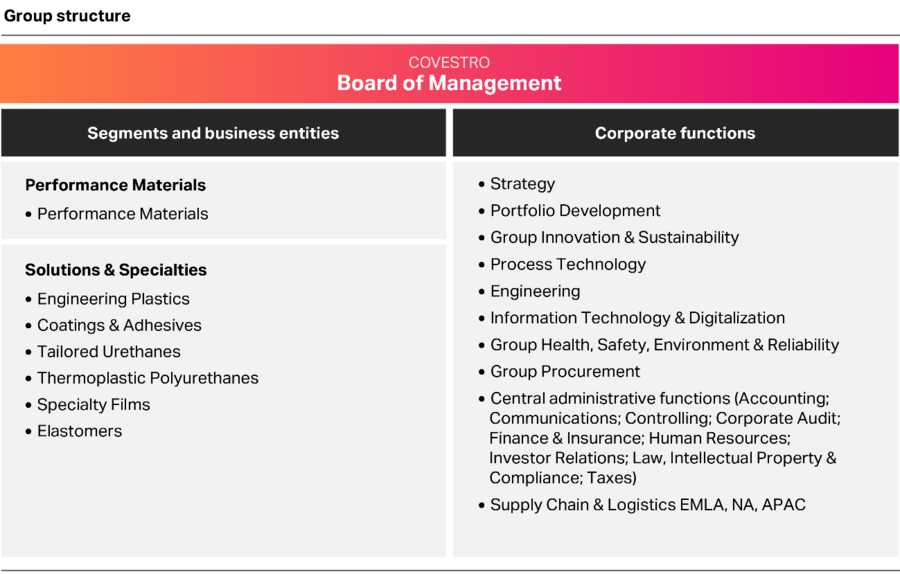
Covestro’s Chief Executive Officer (CEO) is Dr. Markus Steilemann. His area of responsibility includes the corporate functions of Strategy; Group Innovation & Sustainability (GIS); Corporate Audit; Human Resources; and Communications.
Covestro’s Chief Financial Officer (CFO) is Christian Baier. He is responsible for the corporate functions of Accounting; Controlling; Finance & Insurance; Information Technology & Digitalization; Investor Relations; Law, Intellectual Property & Compliance; Portfolio Development; and Taxes. He is also responsible for country-specific topics in the United States and China.
Dr. Thorsten Dreier is the company’s Chief Technology Officer (CTO) and Labor Director. He is responsible for the corporate functions of Process Technology; Engineering; Group Health, Safety, Environment & Reliability (HSER); and Group Procurement. He also coordinates rollout of and compliance with global processes and standards and rollout of initiatives in Covestro’s production network. The Performance Materials business entity also falls within his responsibilities.
Monique Buch has been Covestro’s Chief Commercial Officer (CCO) since August 1, 2025. She is in charge of the Solutions & Specialties segment, including six business entities, all business-related processes and areas of production, procurement, application technology, and sales. She is also responsible for the three regional Supply Chain & Logistics units, which manage internal and external supply chains worldwide. Monique Buch was appointed to the Board of Management already as of June 1, 2025 and, after a two-month transition, took over the position of Sucheta Govil, who left the company on July 31, 2025. This changeover shows that Covestro systematically continues on its strategic path in sales and marketing.
The Supervisory Board oversees and advises the Board of Management. The Supervisory Board has 12 members, half of whom are shareholder representatives and half employee representatives pursuant to the German Codetermination Act. The Chair of the Supervisory Board is Dr. Rainer Seele, who succeeded Dr. Richard Pott in this office effective December 20, 2025, after Dr. Richard Pott had stepped down from this body. Frank Löllgen is the Vice Chair of the Supervisory Board, succeeding Petra Kronen, who stepped down as of December 31, 2024.
For further information, please refer to the “Declaration on Corporate Governance.”
- ↑The number of permanent or temporary employees is stated in full-time equivalents (FTEs). Part-time employees are included on a pro-rated basis in line with their contractual working hours. Board of Management members, employees in vocational training, and interns are not included in this metric because of their special employment relationship.